Process Studies
Vishwas Shinde Elixir Managing Director has worked as Technical Authority for one of the North Sea platform and was instrumental in resolving issues.
- AGR and Gas Plant Troubleshooting in the capacity as Amine Expert
- Platform debottlenecking studies to increase the oil production capacity from 180K BPD to 220K BPD.
- Sand handling in the separators-Debottlenecking of Sulphate Reducing Plant.
Elixir team was engaged in following studies by one of the North Sea Operator
- Amine Swap Out Study (Alternative Amine Solvent to the existing amine solvent)
- Amine Swap Out Study – Phase2 (Adequacy Check of existing System for new solvent)
- AGR Bypass Study-Impact analysis on existing system including material suitability. The study was carried out by Elixir to check the impact of recycling the raw gas with high H2S and CO2 back into the reservoir. The impact of increasing concentration of H2S and CO2 in the fluid stream was reviewed and corrosion modelling done to predict the balance life of the equipment with reference to the current status of each equipment and piping system(available thickness).
- Design verification and assessment for Bouri Gas Utilization Project (BGUP) with associated sour gas of 42% CO2 and 1% H2S for Mellitah Oil and Gas (MOG) in Libya.
- Basic Engineering package was developed for Ethane Evaporation System (steam as heating medium) for Indian Client. It included ethane pumping, evaporator and superheater.
- Best Available Technology (BAT) study for Maersk Al-Shaheen New Centralized Process Platform – Oil and Water Separation Technology Review.
Flow Assurance Studies
Flow assurance expertise ensures the reliable, economic transport of hydrocarbons from reservoir to processing, focusing on preventing flow blockages caused by solids (hydrates, wax, scale, asphaltenes) and managing multiphase flow. Key competencies include thermal-hydraulic modeling, PVT fluid analysis, production chemistry, and transient simulation for subsea, onshore, and arctic systems.
Key Areas of Flow Assurance Expertise
Fluid Characterization & Modeling: Utilizing PVT analysis to understand fluid behavior (wax, asphaltenes, scale) across operating temperatures and pressures.
Transient Simulation for Pipeline Multiphase Flow: Simulating various operational modes mainly startup and shutdown, pipeline depressurization, and pipeline pigging. The mitigation measures such as hydrate inhibitor injection or slug management during pigging is further studied.
Thermal-Hydraulic Analysis: Develop pressure and temperature profile for the pipeline for various operating scenarios and design the systems so as to prevent hydrate formation and wax deposition by managing heat transfer and if not possible then by necessary chemical injections.
Production Chemistry: Managing solids deposition (hydrate issue, scaling potential, wax deposition) and fluid behavior through chemical injection strategies and compatibility testing of chemicals being injected.
Operational Optimization: Developing operating strategies to manage hydrate issues, slugging problems, erosion, and corrosion.
Elixir supports in overcoming Flow Assurance related issues.
Contact Elixir for any support needed.Elixir Experience in Flow Assurance:
Stress Analysis
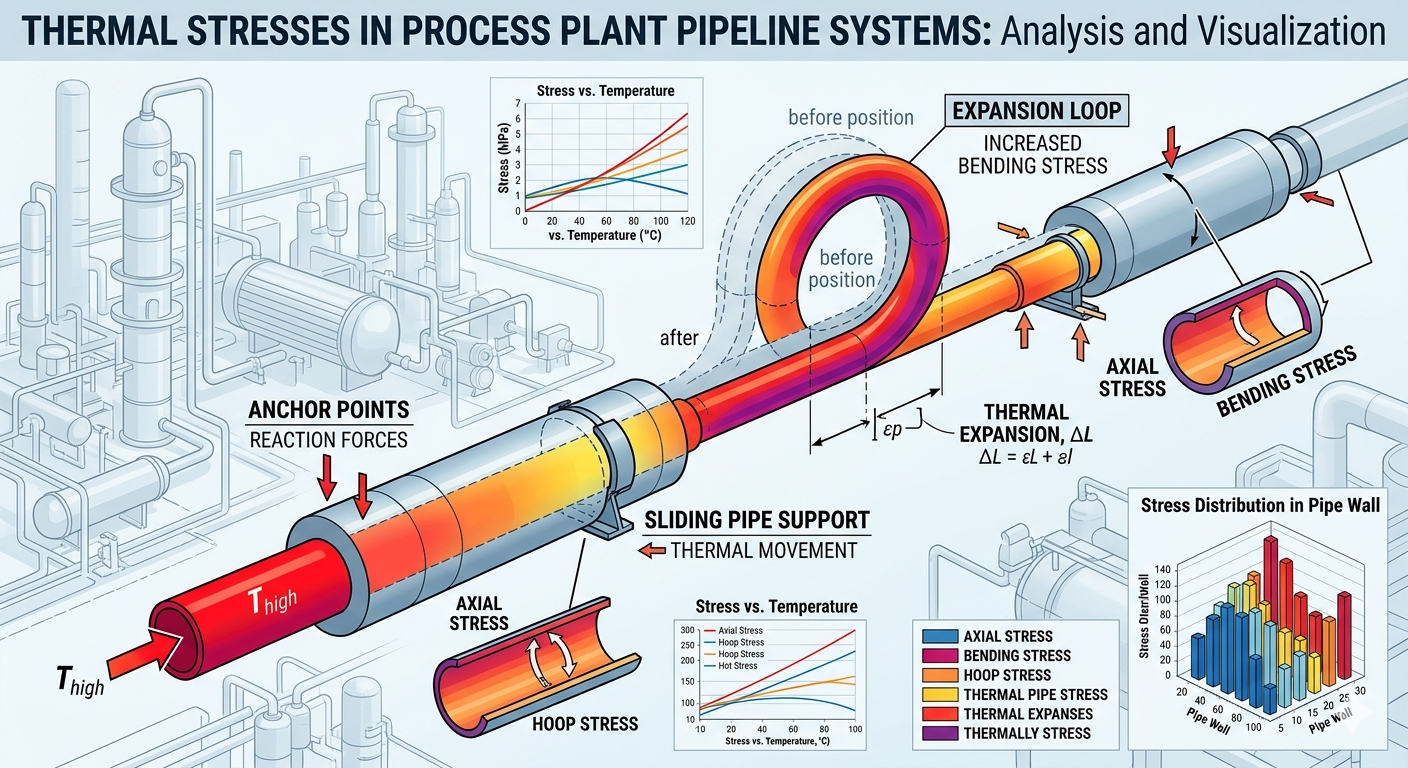
Piping/Pipeline stress analysis ensures piping systems operate safely under pressure, temperature, and weight loads and prevents failures, leaks, and excessive nozzle loads on equipment by checking that system stresses stay within allowable codes (e.g., ASME B31.3).
Key Components of Pipe Stress Analysis
Types of Stress: Analyzes primary stresses (due to weight, pressure) and secondary stresses (due to thermal expansion/contraction).
Load Factors: Considers internal pressure, thermal expansion/contraction, weight, wind, seismic forces, and fluid hammer.
Regulatory Codes: Adheres to standards such as ASME B31.3 (Process Piping), B31.1 (Power Piping), and API 570.
AIV and FIV Screening & Analysis
Flow Induced Vibration (FIV) and Acoustic Induced Vibration (AIV) are major concerns in piping systems. FIV occurs due to turbulent fluid flow, while AIV results from high-frequency pressure fluctuations near control valves, relief valves, and orifices. Both can lead to fatigue failure, structural damage, and operational risks if not properly analyzed.
FIV can lead to structural resonance, fatigue cracks, and mechanical failures in offshore platforms, petrochemical plants, and onshore processing facilities. Proper FIV screening and mitigation ensure safe and reliable operations.
Elixir provides industry-leading Acoustic Induced Vibration (AIV) and Flow Induced Vibration (FIV) screening and analysis services to ensure the mechanical integrity of critical piping systems based on Energy Institute guidelines and CONCAWE 85/52 acoustic fatigue guidance. Elixir services include:
A) Flow Induced Vibration (FIV) Screening & Assessment
Elixir team uses the following approach:
Preliminary and Secondary Screening : Using Energy Institute guidelines, we calculate the Likelihood of Failure (LOF) for each pipeline segment.
ρv² Criteria Analysis: This critical parameter helps to identify turbulence-induced energy risks in pipelines.
Support Span & Stiffness Evaluation: Ensuring adequate support and stiffness to prevent resonance and excessive vibration.
Mainline & Small Bore Connection (SBC) Risk Categorization: Identifying vulnerable small-bore branches and high-risk pipeline sections.
Site Surveys & Construction Audits: Verifying field conditions, including improper bracing, fabrication defects, and misaligned supports.
LOF-Based Recommendations :
LOF < 0.3: Safe under current conditions; routine monitoring recommended.
0.3 ≤ LOF < 0.5: Evaluate SBC integrity; minor modifications may be required.
0.5 ≤ LOF < 1.0: Requires mechanical modifications, such as increased stiffness or additional supports.
LOF ≥ 1.0: Redesign necessary; high-risk zones demand reconfiguration and re-routing.
B) Acoustic Induced Vibration (AIV) Analysis
AIV occurs due to high-frequency pressure fluctuations, often near control valves, relief valves, or restriction orifices in gas systems. Our evaluation includes:
- Sound Power Level (PWL) Calculation: Using Energy Institute guidelines to assess acoustic energy levels.
- Initial Screening: Excluding low-risk pipelines to optimize resources.
- Detailed PWL Mapping: Identifying zones with high acoustic excitation.
- LOF Calculation: Evaluating pipe geometry, thickness, and exposure to high-frequency loads.
- D/T Ratio Analysis: Assessing structural vulnerability based on diameter-to-thickness ratios.
- AIV Mitigation Strategies:
- Low-noise trims: Reduce acoustic energy during pressure reduction.
- Full-wrap reinforcement: Strengthening high-risk zones like tees and bends.
- Two-plane bracing for SBCs: Reducing vibration amplitude.
- Pipe schedule upgrades: Using thicker pipes to meet recommended D/T limits.
C) Combined AIV & FIV Risk Management & Design Validation
Elixir offers holistic vibration risk management services, integrating:
Cross-functional engineering review:
Collaboration between stress, piping, and process teams.
Finite Element Analysis (FEA): Advanced modeling for high-risk scenarios.
Span Optimization & Stiffness Mapping: Ensuring optimal damping and flexibility balance.
Project-Specific Compliance: Aligning recommendations with project piping philosophies.
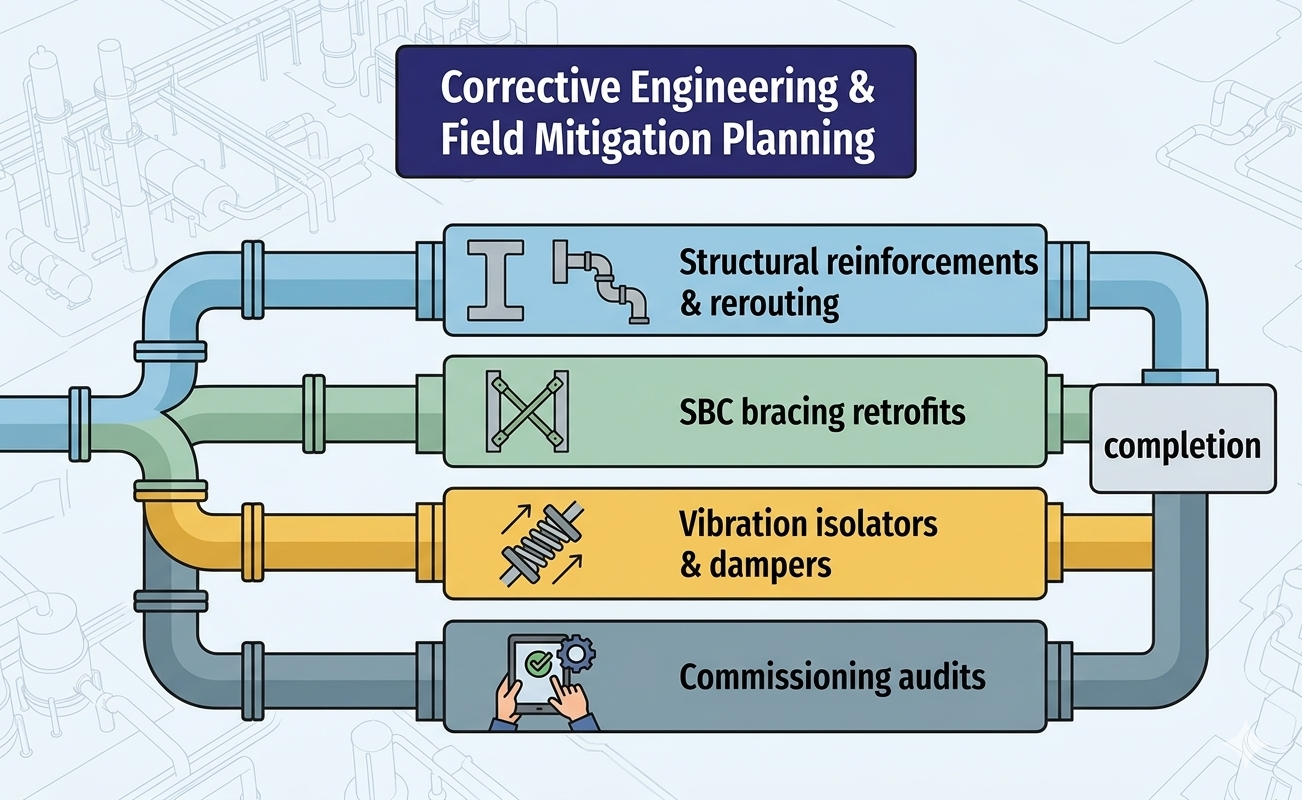
D) Corrective Actions and Mitigation Plans
Reliable FIV & AIV solutions
For high-risk areas, the following engineering solutions are applied:
Structural reinforcements & rerouting: Strengthening joints with clamps, gussets, and wraparounds.
SBC bracing retrofits: Designing field-installable supports.
Vibration isolators & dampers: Absorbing vibration energy to prevent failure.
Commissioning audits: Post-installation vibration monitoring and validation.
Material Selection and Corrosion Studies
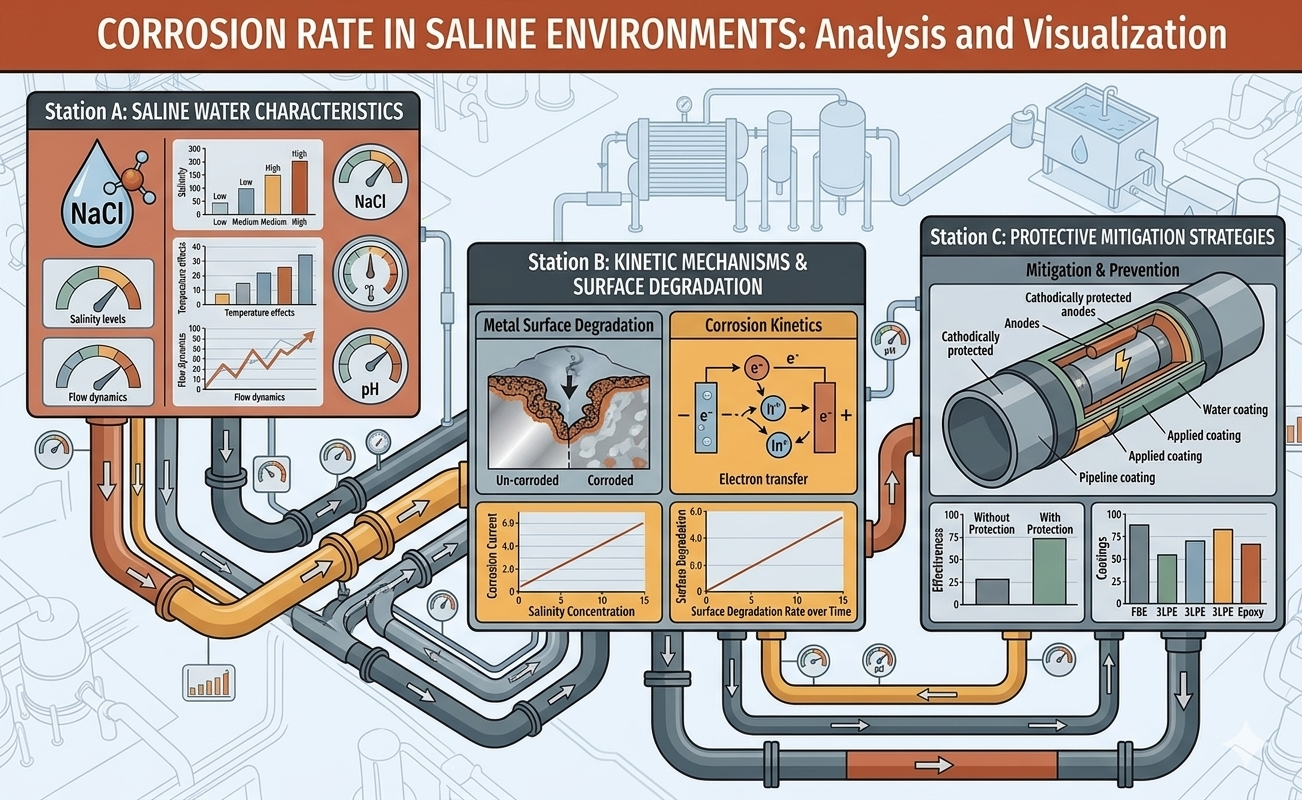
Material selection and corrosion studies are critical for preventing premature equipment failure, reducing maintenance costs, and ensuring safety in engineering applications. Key strategies involve choosing materials—metals, plastics, or coatings—based on environmental compatibility, mechanical strength, and cost, aiming to avoid localized corrosion such as pitting, galvanic corrosion, or stress corrosion cracking.
Key Aspects of Material Selection
Environmental Factors: Consider temperature, concentration, pH, velocity, and impurities (e.g., halides).
Material Types: Materials range from common carbon/stainless steels to high-performance alloys (e.g., 6 Molly), polymers, and ceramics.
Design Considerations: Avoid crevices, consider corrosion allowances, ensure electrical separation to prevent galvanic corrosion, and use inhibitors.
Economic Factors: Material selection is a compromise between cost-effectiveness and the required life expectancy, often favoring life-cycle costs over initial price.
Corrosion Study Techniques
Corrosion studies analyze material degradation to determine appropriate defenses:
Electrochemical Analysis: Evaluating the corrosion potential and rates (e.g., linear polarization resistance).
Surface Analysis: Using microscopic techniques to identify pitting, cracks, or intergranular attacks.
Testing Procedures: Laboratory simulations, immersion tests, and field monitoring to calculate corrosion rates.
Common Corrosion Types
Uniform Corrosion: Consistent loss of thickness across a surface.
Localized Corrosion: Includes pitting, crevice corrosion, and intergranular attack.
Environmentally Induced Cracking: Stress corrosion cracking (SCC) and hydrogen damage.
Galvanic Corrosion: Occurs when two different metals are in contact in an electrolyte
Elixir has expertise in corrosion management which is evident from the projects undertaken as below:
Material Selection Report preparation for:
- Burhan Water Injection Project
- FWS Gas Evacuation Pipeline (100km) project
- Gas distribution network analysis and gas let down station for Jazan City for Primary and Downstream Industries (JCPDI) of Saudi Royal Commission
Computational Fluid Dynamics (CFD)
Computational Fluid Dynamics (CFD) analysis is a numerical method used to simulate fluid flow, heat transfer, and related physical processes. It breaks down complex geometries into smaller cells (meshing) to predict velocity, pressure, and temperature, reducing the need for physical prototypes.
CFD Analysis for Turbine vent stack of ACE BP platform, Azerbaijan
CFD Analysis is being carried out to check the thermal plumes and comustion byproducts of turbine vent stack impacting the nearby equipment, personal access location and helideck.
Finite Element Analysis
Finite Element Analysis (FEA) is a computerized method for predicting how products react to real-world forces, vibration, heat, and fluid flow, helping engineers identify potential design flaws before manufacturing. By dividing complex structures into smaller, simpler "elements" (meshing), FEA simulates physical behavior to optimize performance and improve safety in process industry.
Common Applications :
Structural Analysis: Predicting stress, strain, and deformation to prevent failure.
Thermal Analysis: Simulating temperature distribution and heat transfer to avoid overheating.
Fatigue Analysis: Assessing material lifespan under repeated loading.
Elixir team experience in this area “FEA for Cooling Tower Nozzle Load
- Perform structural assessment of the nozzle using Finite Element Analysis (FEA), in order to check structural Integrity of the Nozzle.
- FEA study was carried-out using ANSYS version 2025 R1 software considering various load combinations.
- Results indicated that nozzle stresses exceeded allowable limits in all cases, resulting in failure.
- Elixir proposed the addition of a saddle support as a cost-effective alternative which was accepted andwas passed during FEA Analysis.

Electrical System Studies
Electric system studies are critical engineering analyses that simulate power network operations to ensure safety, reliability, and efficiency. They identify equipment ratings, optimize performance, and evaluate stability under normal or fault conditions. Essential for design and upgrades, these studies include load flow, short circuit, arc flash, and protection coordination, preventing blackouts and equipment damage.
Key Types of Electric System Studies
Load Flow Analysis: Evaluates voltage levels, power factors, and reactive power management to optimize system efficiency and prevent overloads.
Short Circuit Studies: Calculates fault currents to determine if protective equipment can withstand or interrupt electrical faults.
Protective Device Coordination: Determines optimal settings for relays and breakers to isolate faults quickly, minimizing service interruptions.
Arc Flash Hazard Analysis: Calculates incident energy levels to determine required safety distances and PPE, ensuring personnel safety per safety standards.
Transient/Dynamic Stability Analysis: Simulates system response to significant disturbances (e.g., loss of a generator) to ensure it remains synchronized and stable.
Harmonic Analysis: Assesses the distortion caused by non-linear loads (e.g., VFDs, solar inverters) to prevent equipment overheating.
Motor Starting Studies: Analyzes voltage drops and current inrush during large motor startup to prevent system instability.
Elixir experience in this area:
Electrical Studies :
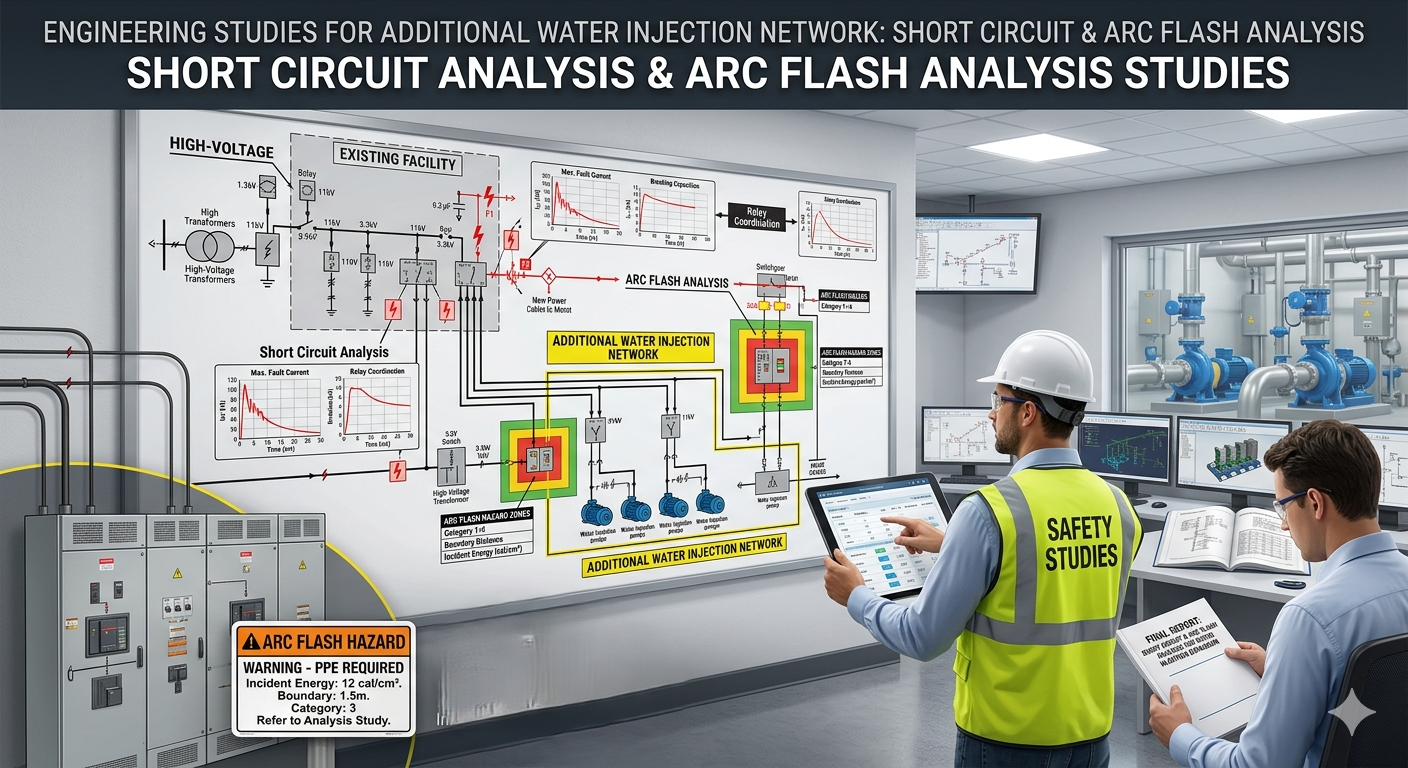
Load Flow and Motor Starting Analysis for Yamama Field Iraq (Gas Plant).Short Circuit Analysis and Arc Flash Analysis studies carried out for additional network of Burhan Water Injection to the existing EPF, Oman. Scope of this study is to evaluate the maximum short circuit currents at several system busbars in existing EPF under different operative configurations of the new electrical network for Water Injection facility. Relay setting calculations for the Indian Vendor.Lightening Risk Assessment for Fabrication Workshop building in India.Cable Tray Routing Study for Rolls Royce Small Modular Reactors, UK.Short circuit current study and relay coordination study for TAQA Brae Alpha Platform (Existing pumps of 55 KW were upgraded for 110 KW for capacity enhancement).